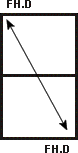
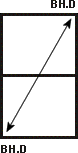
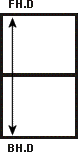
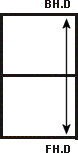
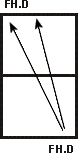
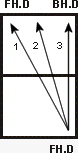
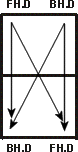
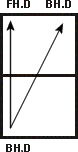
FH.D=Forehand drive BH.D=Backhand drive Drive=Basic power shot with no or little topspin executed close to the table. Forehand=The right side of a right-handed player. Backhand=The left side of a right handed player.
Exercise 1
Both players play forehand drive diagonally.
Exercise 2
Both players play backhand drive diagonally.
Exercise 3
Parallel forehand & backhand drive. One player plays forehand drive and the other backhand drive.
Exercise 4
Same as the previous exercise. The players change sides.
Exercise 5
Both players play forehand drive. The first ball diagonally to the forehand side and the second to the center. Good for footwork.
Exercise 6
1. Diagonally to the forehand side. Both players plays forehand drive. 2. To the center. Both players plays forehand drive. 3. Parallel to the backhand side. One player plays forehand drive and the other backhand drive.
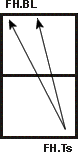
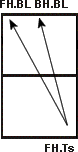
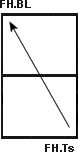
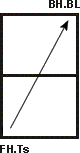
FH.D=Forehand drive BH.D=Backhand drive FH.BL=Forehand block BH.BL=Backhand block FH.Ts=Forehand topspin Drive=Basic power shot with no or little topspin executed close to the table Block=Basic defensive shot for topspin countering Topspin=Offensive shot with heavy topspin executed close to the table Forehand=The right side of a right-handed player Backhand=The left side of a right handed player
Exercise 1
One player plays diagonally and the other parallel.
Exercise 2
One player plays parallel and diagonal with his backhand and the other moves across the table with forehand and backhand.
Exercise 3
One player plays forehand topspin diagonally ang in the middle. The other player plays forehand block from his forehand and in the middle.
Exercise 4
Same as the previous exercise. The difference is that the player who plays block uses both his forehand and his backhand.
Spin - the hidden side of table tennis. So what happens when you impart spin onto a table tennis ball?
Spin plays an important role in the sport of table tennis, so if you're intending to play at an advanced level, you'll need to master this vital skill.
Generally, the ball is struck with either topspin or backspin - although sidespin may also be added.
Let's have a look at each of these table tennis techniques in turn ...
1. Topspin
Topspin is produced by starting your stroke below and/or behind the ball and brushing the ball in an upward and forward motion.
2. Backspin
Backspin is produced by starting your stroke above and/or behind the ball and
brushing the ball in a downward and forward motion
3. Sidespin
Depending on whether your racket moves to the right or to the left, you'll impart different sidespin
Sidespin is produced by brushing the ball in a sideways motion
So what happens when you impart spin onto a table tennis ball?
Spin effect
When you impart topspin onto the ball, it has a higher trajectory and 'kicks' off the table surface in an upwards direction.
When you impart backspin onto the ball, it has a much lower
trajectory which causes it to stay low as it bounces off the table surface.
When you impart sidespinonto the ball, the ball will bounce off your opponent's racket in the same direction that your racket was travelling when you hit the ball
Using excessive spin is particularly effective when you serve.
Spin practice
Being able to play good spin shots relies on good ball control. If you're a beginner, I'd recommend that you use the following exercises to improve your table tennis technique:
Using the forehand side of your racket and a loose wrist action, bounce the ball vertically to a height of approximately 30cm (12 inches), imparting sidespin.
Repeat 1 above, but use the opposite sidespin.
Repeat the above, but use each side of your racket alternately.
My table tennis techniques:
When practising these exercises, try to ensure that the ball bounces as near to vertical as possible.
Also, ensure that your wrist action produces most of the movement necessary to produce the spin - and that you use a light touch.
As you improve, it's important to develop a variety of strokes because basic spin will be easy for your opponents to read.