THE TEN COMMANDMENTS OF TABLE TENNIS
I. Play whatever style you want. Don't let others dictate how you have to play, but listen to advices in order to improve. Your style could be an extension of your personality. The more styles the game has, the richer it is. Bring something to the game.
Be yourself.
II. Play whatever equipment you want, but it should not limit your tactical options or shoot selection. Use stuff you can handle. Know how other equipment plays.
Experimentation is the key.
III. Develop tactics and counter-tactics. To handle serves, points, matches, opponent's equipment, opponent's styles, opponent's behavior, opponent's tactics, anything. Think before, during and after playing.
Be smart.
IV. Respect others. Ask for being respected. Don't use tactics to upset, scare or bother opponents, don't CHO! every point. Play if somebody asks you to play. Try to have fun and let others have his share of fun too. Give advices and help other players.
And be gentle.
V. Learn to win. Learn to loose. Accept your mistakes, limitations and defeats and don't complain when you loose. You lost because you deserved it.
Be modest.
VI. There is no luck. Place your shots and you'll get nets and edges. Instead of sobbing when your opponent gets a net or edge, learn to return those balls.
Be focused.
VII. Improve your style and technique. Improving your weaknesses should be easy than improving your strengths, and remember that a smart opponent will capitalize on your weaknesses. First decide what to train, why and how are you going to do it, then train.
Learn to rally.
VIII. Rules and equipment will change, so certain styles or equipment can be favored. You can change yours anytime. You can also accept those changes and play at certain disadvantage. Styles less favored, or even harmed by rules can still win. It will be just harder.
Never whine.
IX. No unfair equipment exists. No styles are bad to the sport. No players are inferior or superior athletes by any means, and of course you are not entitled to judge nobody. Leave the sport if you think different than this.
X. The only laws to respect are the rules of the game. This is the only mean that shows you how the game is supposed to be played. Read it, obey all the rules, and enforce them. Try to exploit rules to your advantage.
But be legal.
check my ink

Wednesday, October 21, 2009


Tuesday, October 20, 2009
Table Tennis Blade And Rubber Combinations For Beginners
For the serious beginner...
Note :-Equipment Changes with time.
BLADES:-
Butterfly Primorac Off-
(Hold the blade in your hand b4 buying it and see how comfortable u r with it ,that is the best way to choose :) )
~Price About Rs.1200 to Rs.2000
Avoid – hard fast blades with synthetic materials; i.e. – Carbon, Kevlar, etc. If you really “must” have a Synthetic blade go for something that still is controllable like Waldner Carbon or Diablo Senso.
MY thoughts – lighter does NOT always= better. So don’t just automatically ask for a light blade. 9 out of 10 newbies ask for a light blade. They don’t know why, but they think it’s the thing to ask for. Many of the best blades that people rave about are on the heavier side (i.e. Stiga Offensive Classic, Petr Korbel etc.) This is because: since mass=power, manufactures can produce a softer controllable blade with a nice feel, that still has an acceptable power level. Light, stiff, hard blades with the same power level wont have the same dwell time, feel and touch. If little 10-year-old girls can swing a 90-gram blade; you can to.
RUBBER:-
Yasaka Mark V
Always try to Use Practice Balls for Practice and 3*** star balls to Practice game play.
Click the Red Link Below To shop Online
Table Tennis Bats and Rubbers
Note :-Equipment Changes with time.
BLADES:-
Butterfly Primorac Off-
- Excellent quality, allround blade for the 40mm ball, can be used to loop, hit, chop.
- Excellent blade that will last a time.
- Limba outer plies, flexability, excellent feel
(Hold the blade in your hand b4 buying it and see how comfortable u r with it ,that is the best way to choose :) )
~Price About Rs.1200 to Rs.2000
Avoid – hard fast blades with synthetic materials; i.e. – Carbon, Kevlar, etc. If you really “must” have a Synthetic blade go for something that still is controllable like Waldner Carbon or Diablo Senso.
MY thoughts – lighter does NOT always= better. So don’t just automatically ask for a light blade. 9 out of 10 newbies ask for a light blade. They don’t know why, but they think it’s the thing to ask for. Many of the best blades that people rave about are on the heavier side (i.e. Stiga Offensive Classic, Petr Korbel etc.) This is because: since mass=power, manufactures can produce a softer controllable blade with a nice feel, that still has an acceptable power level. Light, stiff, hard blades with the same power level wont have the same dwell time, feel and touch. If little 10-year-old girls can swing a 90-gram blade; you can to.
RUBBER:-
Yasaka Mark V
- medium-soft sponge
- grippier than sriver, great control.
- ~About Rs.800
- medium hardness (med soft for EL)
- great control, grippy
- ~About Rs.800
- medium->medium hard sponge
- soft tacky surface, excellent control, not as fast as above.
- About Rs.450
Always try to Use Practice Balls for Practice and 3*** star balls to Practice game play.
Click the Red Link Below To shop Online
Table Tennis Bats and Rubbers
Thursday, October 8, 2009
Some Table Tennis Bats


1) Is there any guides to doing this that you all endorse? think you tube has some... take old sheets off. slowly and carefully not to damage blade esp if its not been varnished. put the blade on the fresh sheet draw around it with a pen, use wet scissors to cut it out, put glue on both rubber and blade let it dry a little and then stick down, use a rolling pin (softly) to get a nice even spread.) then retrim.
2) do I really need special glue or can I use rubber cemement or any other cheaper alternatives? copydex can be used as an alternative
3) When I order a "Sheet" you need 2 sheets of of rubber, depending on your style you could get different ones for FH and BH to fit your game better.
4 The tape that goes around the edges, where can you purchase this and is it crucial?
No not crucial, it is cheap any where that sells rubbers should also sell this. you can use electrical tape instead
Saturday, September 5, 2009
Table Tennis Exercise - 1
FH.D=Forehand drive
BH.D=Backhand drive
Drive=Basic power shot with no or little topspin executed close to the table.
Forehand=The right side of a right-handed player.
Backhand=The left side of a right handed player.
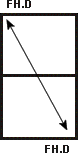 | 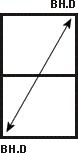 | 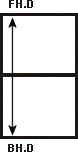 |
| Exercise 1 Both players play forehand drive diagonally. | Exercise 2 Both players play backhand drive diagonally. | Exercise 3 Parallel forehand & backhand drive. One player plays forehand drive and the other backhand drive. |
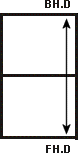 | 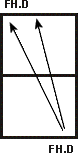 | 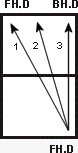 |
| Exercise 4 Same as the previous exercise. The players change sides. | Exercise 5 Both players play forehand drive. The first ball diagonally to the forehand side and the second to the center. Good for footwork. | Exercise 6 1. Diagonally to the forehand side. Both players plays forehand drive. |
Table Tennis Exercise - 2
FH.D=Forehand drive
BH.D=Backhand drive
FH.BL=Forehand block
BH.BL=Backhand block
FH.Ts=Forehand topspin
Drive=Basic power shot with no or little topspin executed close to the table
Block=Basic defensive shot for topspin countering
Topspin=Offensive shot with heavy topspin executed close to the table
Forehand=The right side of a right-handed player
Backhand=The left side of a right handed player
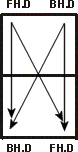 | 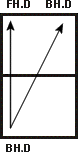 | 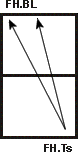 |
| Exercise 1 One player plays diagonally and the other parallel. | Exercise 2 One player plays parallel and diagonal with his backhand and the other moves across the table with forehand and backhand. | Exercise 3 One player plays forehand topspin diagonally ang in the middle. The other player plays forehand block from his forehand and in the middle. |
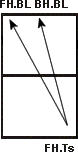 | 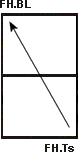 | 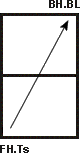 |
| Exercise 4 Same as the previous exercise. The difference is that the player who plays block uses both his forehand and his backhand. | Exercise 5 Forehand tospin diagonally to the forehand side. | Exercise 6 Forehand topspin diagonally to the backhand side. |
Table Tennis Techniques Spin ... the hidden side.
Spin - the hidden side of table tennis.
So what happens when you impart spin onto a table tennis ball?
Spin plays an important role in the sport of table tennis, so if you're intending to play at an advanced level, you'll need to master this vital skill.
Generally, the ball is struck with either topspin or backspin - although sidespin may also be added.
Let's have a look at each of these table tennis techniques in turn ...

1. Topspin
Topspin is produced by starting your stroke below and/or behind the ball and brushing the ball in an upward and forward motion.
2. Backspin

3. Sidespin

Sidespin is produced by brushing the ball in a sideways motion
So what happens when you impart spin onto a table tennis ball?


Spin effect
When you impart topspin onto the ball, it has a higher trajectory and 'kicks' off the table surface in an upwards direction.

When you impart backspin onto the ball, it has a much lower
trajectory which causes it to stay low as it bounces off the table surface.


When you impart sidespin onto the ball, the ball will bounce off your opponent's racket in the same direction that your racket was travelling when you hit the ball

Using excessive spin is particularly effective when you serve.
Spin practice
Being able to play good spin shots relies on good ball control. If you're a beginner, I'd recommend that you use the following exercises to improve your table tennis technique:
Using the forehand side of your racket and a loose wrist action, bounce the ball vertically to a height of approximately 30cm (12 inches), imparting sidespin.
Repeat 1 above, but use the opposite sidespin.
Repeat the above, but use each side of your racket alternately.
My table tennis techniques:
When practising these exercises, try to ensure that the ball bounces as near to vertical as possible.
Also, ensure that your wrist action produces most of the movement necessary to produce the spin - and that you use a light touch.
As you improve, it's important to develop a variety of strokes because basic spin will be easy for your opponents to read.
"Vicky"
waiting 4 ur comments....
Subscribe to:
Posts (Atom)